From Lab-Bound to Handheld: The 60-Year Evolution of 3D Scanning
Introduction
If you use a 3D scanner today, you are likely accustomed to a workflow that feels remarkably fluid. You wave a handheld device around an object—or perhaps just slowly pan your smartphone—and within minutes, a high-fidelity point cloud or textured mesh appears on your screen. It is easy to take this seamless process for granted.
However, the journey to this level of handheld precision was anything but smooth. It required overcoming massive hurdles in optical physics, computational power, and algorithmic software design. To truly appreciate the technology sitting on your desk (or in your pocket), we have to look back at the specific technological leaps that untethered 3D scanning from the laboratory.
1. Before 3D Scanning: The Era of Physical Contact
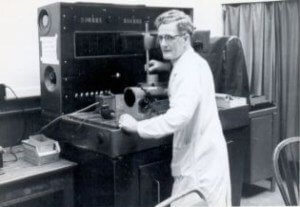
Before light and lasers were used to capture geometry, reverse engineering and reality capture were strictly physical. In the early to mid-20th century, replicating a complex shape meant relying on plaster casting, manual calipers, or contour gauges.
The closest analogue to modern 3D scanning was the Coordinate Measuring Machine (CMM), invented in the late 1950s
by Ferranti of Scotland. CMMs use a physical probe—often a ruby-tipped sphere—to touch an object at various points. By recording the $(X, Y, Z)$ coordinates of each touch, operators could slowly build a wireframe of an object.
The Problem
: CMMs were precise, but they were also slow, expensive, and bolted to the floor. Also, the probes could not scan soft or fragile shapes without damaging them, making medical CMM measurements impossible.
2. 1960s to 1980s: The Birth of Digital Optical Scanning
The foundational concepts of non-contact 3D scanning emerged in the 1960s using optical triangulation. By shining a light on an object and observing it from an offset camera, the system could calculate depth based on where the light fell on the sensor.
While the physics were sound, the execution was limited by the era’s hardware:
-
The Hardware Challenge: Early lasers were massive, power-hungry, and cameras used low-resolution sensors.
-
The Computing Challenge: Calculating thousands of points per second was far beyond 1970s computers. Scanning a single object took hours of processing, and the results were noisy.
In the late 1980s, the entertainment industry pushed commercial 3D scanning forward. The company Cyberware created 3D scanners films like Star Trek IV and Terminator 2: Judgment Day. However, these still required the subject to remain perfectly still while a mechanical rig rotated a heavy laser array around them.
3. 1990s: Structured Light and The Registration Problem
The 90s saw the rise of Structured Light scanning. Instead of a single laser, these scanners project a known pattern onto the subject. As the pattern wraps around the object, it deforms; a camera reads this distortion to calculate the 3D shape.
Historical Milestone: The "Stanford Bunny"
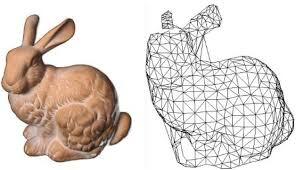 In 1994, Stanford University researchers used a Cyberware scanner to capture a terracotta figurine. The resulting "Stanford Bunny" (69,451 triangles) became the global standard test model for computer graphics algorithms.
The Software Bottleneck
Despite these advances, scanners were still bolted to tripods because of the "Registration Problem." If a scanner moved freely, the computer couldn't tell how "Scan A" related to "Scan B." Users also had to spend hours manually stitching point clouds together in software.
4. 2000s: The SLAM Revolution and the First Handhelds
To achieve true mobility, the scanner needed to know where it was in 3D space at all times. The solution came from robotics: SLAM (Simultaneous Localization and Mapping).
SLAM allows a device to build a map of an unknown environment while tracking its own location within that map. In 3D scanning, SLAM uses the geometry it captures as anchors to track the scanner’s movement in real-time.
| Feature | Traditional Tripod Scanning | Handheld SLAM Scanning |
| Mobility | Fixed; requires manual repositioning | Full freedom of movement |
| Speed | Slow (requires multiple setups) | Fast (continuous capture) |
| Alignment | Manual "stitching" in post-processing | Real-time automatic registration |
| Hardware | Heavy tripods/Robotic arms | Lightweight handheld units |
By the late 2000s, companies like Artec 3D released handheld scanners. While the scanners were portable, they were still tethered to high-performance laptops via thick cables to handle the massive data bandwidth.
5. 2010s: Democratization and the "Kinect Effect"
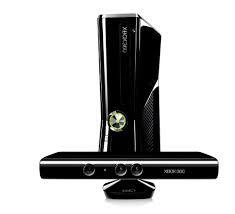
In 2010, the Microsoft Kinect changed everything. Powered by PrimeSense technology, it was a $150 gaming accessory that was actually a sophisticated infrared structured-light scanner.
The hacking community immediately realized its potential. Developers (including Occipital, Structure's parent
) wrote open-source drivers that turned the Kinect into a rudimentary handheld 3D scanner. It proved that depth-sensing hardware could be miniaturized and mass-produced cheaply.
6. 2020s to Present: LiDAR in Your Pocket
The final leap to ubiquitous mobility was driven by the smartphone industry and the refinement of Time-of-Flight (ToF) LiDAR.
Instead of patterns or triangulation, ToF LiDAR sends out light pulses and measures exactly how long (in nanoseconds) they take to bounce back.
-
Apple’s Influence: Apple introduced LiDAR to the iPad Pro and iPhone Pro lines in 2020.
-
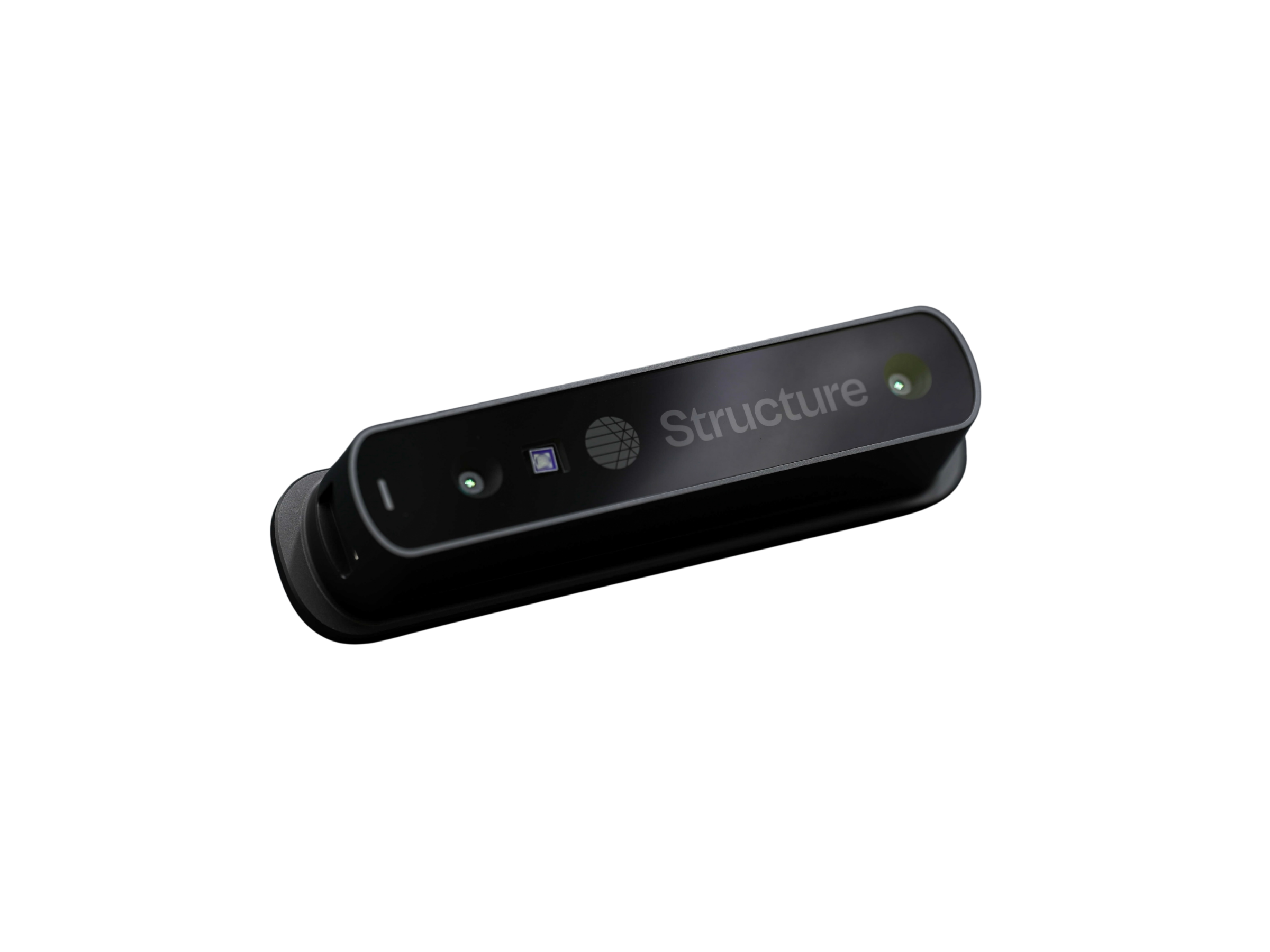
Occipital & Structure: Companies like Structure continued to evolve portable IR scanning, creating independent hardware (like the Structure Sensor 3) for high-accuracy professional needs.
The Current Landscape
Today, the "heavy lifting" has moved to the Cloud. Apps like Structure Capture allow you to perform LiDAR sweeps or TrueDepth scans on a phone, offloading the processing power required for high-fidelity meshes to remote servers.
Summary
The evolution of 3D scanning is a dance between hardware and software. The physical limitations of tripods were solved by SLAM algorithms; the computational bottlenecks of the 80s were solved by mobile processors and the cloud.
Today, as you scan an object for a 3D print or a digital twin, you are holding sixty years of metrology, optical physics, and computer science in the palm of your hand.