3D Scanning 101: LiDAR, Stereo IR, or Photogrammetry?
In the world of 3D reality capture, there is no "one size fits all" solution. Whether you are a game developer, an architect, or a medical professional, the tool you choose determines the quality of your digital twin.
Today, three technologies dominate the market: LiDAR, Stereo IR (Structured Light), and Photogrammetry. Here is how they stack up and, more importantly, which one is best suited for your needs.
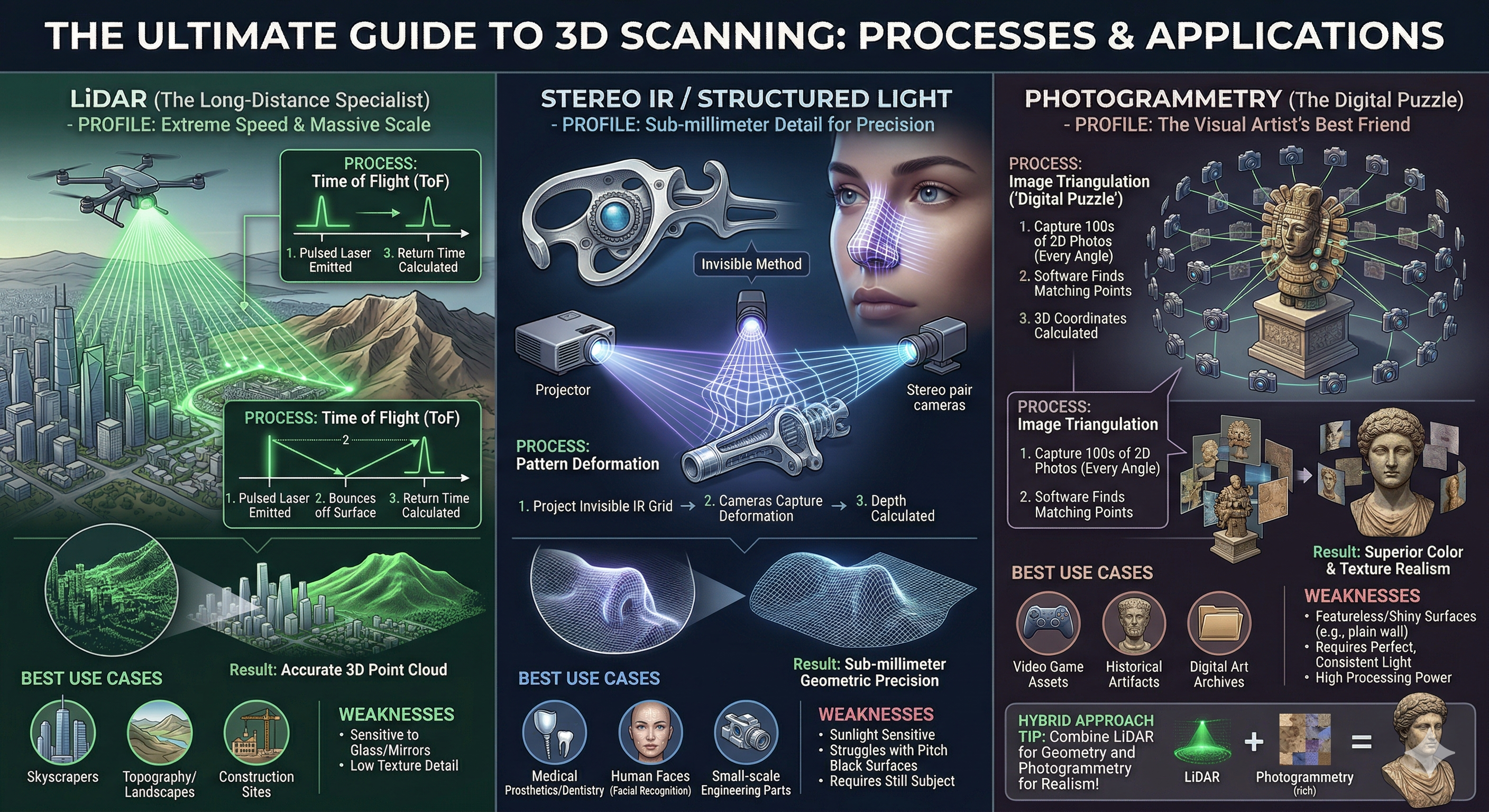
1. LiDAR: The Long-Distance Specialist
LiDAR (Light Detection and Ranging) is the "heavy lifter." It works by firing rapid laser pulses and measuring the time it takes for them to bounce back. This is known as "Time of Flight" (ToF).
- Profile: Extreme speed and massive scale.
- Strengths: Because LiDAR generates its own light, it provides incredible spatial accuracy over long distances (hundreds of yards). The lasers used in LiDAR are also resistant to environmental noise like sunlight.
- Weaknesses: LiDAR struggles with glass and mirrors because the laser passes through or reflects off these surfaces. And since LiDar determines distance by dividing the speed of light by time, its accuracy is measured in centimeters. This is not a fault of the technology - light just moves very fast.
2. Stereo IR & Structured Light: The Precision Surgeon
If LiDAR is a floodlight, Infrared (IR) Scanning and Structured Light are the scalpels. These systems project an invisible pattern of light onto an object. By watching how that pattern deforms over surfaces—like the bridge of a nose or the curve of a gear—the scanner calculates depth with sub-millimeter precision.
- Profile: Sub-millimeter precision.
- Strengths: IR is the gold standard for scanning people. Since IR light is invisible to the human eye, there are no blinding flashes and is safe for use on human subjects, making it perfect for medical applications and high-end engineering where every micron counts. It’s the same tech powering the FaceID software in the Apple Ecosystem, making it the most accessible option of the three.
- Weaknesses: Environmental Sensitivity: Since IR scanners use their own light "language", excessive sunlight will wash out the projected grid, and pitch-black surfaces will absorb the light grid. Because IR projects a pattern over time, any movement from the subject can cause "ghosting" or distorted geometry.
3. Photogrammetry: The Digital Puzzle
Photogrammetry is the most accessible method because it doesn't require specialized lasers—just a good camera. By taking hundreds of 2D photos from every possible angle, specialized software identifies "matching points" to triangulate the 3D position of the object.
- Profile: The Visual Artist’s Best Friend.
- Strength: While it might lag behind IR in pure geometric measurements, Photogrammetry wins the "Beauty Pageant." It captures photorealistic textures and colors that lasers simply can’t match.
- Weakness: Photogrammetry needs "landmarks" to align photos. If you try to scan a plain white wall or a shiny chrome bumper, the software will get confused because every pixel looks identical. Unlike LiDAR, photogrammetry is an "active" listener. If your lighting changes between shots (like a cloud passing over the sun), the software will likely fail to stitch the images together. You’ll need a surplus of GPU and a lot of patience to process 500 photos into a single 3D model, often requiring a computer to generate the model.
Comparison at a Glance
|
Feature |
LiDAR |
Stereo IR / Structured Light |
Photogrammetry |
|
Primary Strength |
Range & Spatial Accuracy |
Geometric Detail |
Color & Texture Realism |
|
Ideal Subject |
Buildings, Landscapes |
Small Parts, Human Body |
Art, Artifacts, Assets |
|
Lighting Needs |
Works in total darkness |
Best in controlled light |
Requires perfect, even light |
|
Ease of Use |
High (Automatic) |
Moderate (Requires calibration on devices, smartphone-ready) |
Medium (Computer-tethered) |
Which is Right for You?
Choose LiDAR if...
You are documenting a construction site, mapping a large interior space, or need to capture the topography of a landscape. If your project is measured in meters or kilometers, LiDAR is your only choice.
Choose Stereo IR / Structured Light if...
You are working in a doctor’s office, a machine shop, a DIY hobbyist, or a digital archivist (if accurate measurements are more important than vibrant detail) If you need to 3D print a replacement part for an engine or fabricate a custom prosthetic for a patient, the precision of IR is unmatched.
Choose Photogrammetry if...
You are a game designer or a digital archivist (if accurate measurements are less important than vibrant detail). If the goal is to make a 3D model look as "real" as possible—capturing the moss on a rock or the brushstrokes on an oil painting—Photogrammetry provides the superior visual fidelity your project needs. And since your clients will be viewing your work in a different scale or environment, accurate measurements are not as important.
The Path Forward
Ultimately, the "right" choice isn't about which technology is technically "better"—it's about which one serves your current goal without creating unnecessary headaches or destroying your budget.
Don't let analysis paralysis hold you back. If you are building massive game worlds, look to LiDAR for the landscape and photogrammetry for the assets. If you are designing bespoke medical devices, Stereo IR is your path forward. Whatever your specific project, use this guide to make an informed decision, choose your tool, and start capturing.